There is no single best radon detector for every home. This page compares three digital monitors, Airthings Corentium Home, Ecosense EcoQube and Ecosense EcoBlu, using only what each manufacturer states. EPA says a short-term result of 4 pCi/L or higher should be followed by another test.
Radon detector comparison
Corentium Home states an LCD on the device and battery power. EcoBlu states an LED screen and plug-in power with no phone needed. EcoQube states results in an app and requires 2.4 GHz Wi-Fi. Each cell below is the manufacturer’s own statement, as reported on our review pages.
The table lists each product with its manufacturer-stated features. Images link to the Amazon listing. Product listings and images come from Amazon; check the listing for current price and availability.
More detail on three detectors
The next table keeps the specs our review pages report for the EcoQube, EcoBlu and Corentium Home. For the Corentium Home, see the model note below, because Airthings now sells a newer model.
Source: manufacturer-stated, as reported on each review page: EcoQube EQ100, EcoBlu EB100 and Corentium Home. We list no prices. Radon.org did not test these devices. See our affiliate disclosure for how Amazon links work.
EcoQube vs Corentium Home
On our review pages, EcoQube is stated to use a pulsed ionization chamber, require 2.4 GHz Wi-Fi and show results in an app. Corentium Home 2 is stated to use alpha spectrometry, show averages on an LCD and run on 2 AA batteries without an app. Read the EcoQube EQ100 review and the Corentium Home review.
View the EcoQube EQ100 on Amazon · View the Corentium Home on Amazon

Best for: Wi-Fi app and smart-home integrationEcosense EcoQube EQ100
Manufacturer-stated
- Wi-Fi connected, app enabled
- First reading 10 minutes after the power cable is connected
- IFTTT smart-home integration
Check price on Amazon 
Best for: Portable with Bluetooth appAirthings Corentium Home 2 (325)
Manufacturer-stated
- Bluetooth connectivity
- Adds temperature and humidity sensors
- App graphs of radon over time
Check price on Amazon What to compare
We do not rank these monitors. A buyer can compare them on the criteria below, using each manufacturer’s own statements.
- How results are shown: on the device, in an app, or both.
- Power: batteries or a plug-in adapter.
- Connectivity: whether Wi-Fi or a phone is required.
- Detection method: as the manufacturer states it.
- Stated accuracy and measurement range: and the conditions attached to them.
- Warranty: length and any registration requirement.
A note on the Corentium Home model
Airthings’ current product page is for Corentium Home 2. Airthings’ comparison on that page lists Corentium Home 1 as the previous model, with no connectivity, a radon-only sensor, 3 batteries and 2 years of battery life. Radon.org links two Airthings Corentium Home listings on Amazon, and they are described separately here. The Corentium Home (223) listing states battery operation (3 AAA), a portable and lightweight design, on-screen short-term readings and a radon self-inspection report. The Corentium Home 2 (325) listing states Bluetooth connectivity, added temperature and humidity sensors and app graphs of radon over time. See the full Airthings product page.

Best for: Portable, battery-poweredAirthings Corentium Home (223)
Manufacturer-stated
- Battery operated (3 AAA)
- Portable and lightweight
- On-screen short-term readings
- Radon self-inspection report
Check price on Amazon Airthings Wave
Airthings Wave is listed as a battery-operated detector with a Bluetooth app. The manufacturer states that you wave in front of the device to see a green, yellow or red indication, and that it includes humidity and temperature sensors. Radon.org has not tested this device, so read the Amazon listing and the maker’s instructions before you decide. EPA says a short-term result of 4 pCi/L or higher should be followed by another test.

Best for: Wave-to-check color indicatorAirthings Wave (2950)
Manufacturer-stated
- Battery operated
- Wave in front for a green/yellow/red indication
- Bluetooth app
- Humidity and temperature sensors
Check price on Amazon Airthings Wave Plus
Airthings Wave Plus is listed with sensors for radon, CO2, VOC, humidity, temperature and pressure, powered by 2 AA batteries and paired with a Bluetooth app. These are the manufacturer’s statements. That makes it a radon monitor that also reports other air readings, which may suit a household that wants more than a radon number. Radon.org has not tested this device. EPA says a short-term result of 4 pCi/L or higher should be followed by another test.

Best for: Radon plus air quality sensorsAirthings Wave Plus (2930)
Manufacturer-stated
- Radon, CO2, VOC, humidity, temperature and pressure sensors
- 2 AA batteries
- Bluetooth app
Check price on Amazon Airthings View Radon
Airthings View Radon is listed as battery powered, with Wi-Fi and app alerts. The manufacturer states that its display can show up to four values and that it includes humidity and temperature sensors. A Wi-Fi monitor suits people who want alerts on a phone as well as readings on the device itself. Radon.org has not tested this device. EPA says a short-term result of 4 pCi/L or higher should be followed by another test.
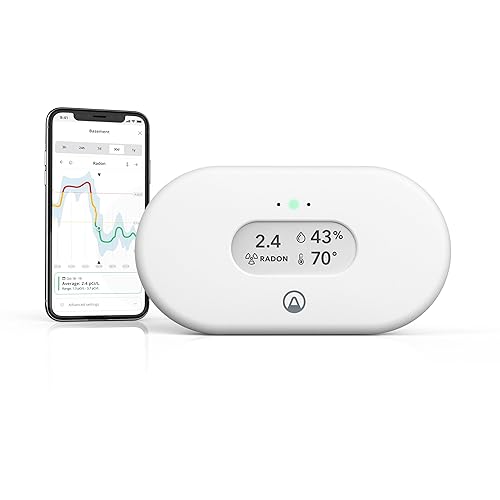
Best for: Display with Wi-Fi appAirthings View Radon (2989)
Manufacturer-stated
- Battery powered
- Wi-Fi and app alerts
- Display can show up to four values
- Humidity and temperature sensors
Check price on Amazon Airthings View Plus and Wave Plus bundle
This Airthings bundle pairs two monitors for two rooms. The manufacturer states that View Plus is Wi-Fi connected and measures radon, PM2.5, CO2, VOC, humidity and temperature, and that the bundle adds a battery-operated Wave Plus for a second room. Placement matters as much as the device, so follow the maker’s instructions. Radon.org has not tested either device. EPA says a short-term result of 4 pCi/L or higher should be followed by another test.

Best for: Two-room radon and air qualityAirthings View Plus and Wave Plus bundle
Manufacturer-stated
- View Plus is Wi-Fi connected and measures radon, PM2.5, CO2, VOC, humidity and temperature
- Bundle adds a battery-operated Wave Plus for a second room
Check price on Amazon SunRADON luft
SunRADON luft is listed as a plug-in monitor with Wi-Fi and app alerts. The manufacturer states that it also tracks VOCs, eCO2, temperature, pressure and humidity, and that its front LED can be used as a nightlight. It is one of several Wi-Fi options in this guide, so compare how each one shows results and sends alerts. Radon.org has not tested this device. EPA says a short-term result of 4 pCi/L or higher should be followed by another test.

Best for: Plug-in Wi-Fi radon and air qualitySunRADON luft
Manufacturer-stated
- Plug-in, Wi-Fi with app alerts
- Also tracks VOCs, eCO2, temperature, pressure and humidity
- Front LED can be a nightlight
Check price on Amazon SunRADON XP professional monitor
SunRADON XP Professional Continuous Radon Monitor is professional-grade equipment, not a basic home monitor. The manufacturer states that it is NRPP and NRSB approved, with a color touchscreen, Bluetooth and an optional cellular module. It is aimed at professional testers, so a household comparing home monitors can use the other options in this guide as a starting point. Radon.org has not tested this device. EPA says a short-term result of 4 pCi/L or higher should be followed by another test.

Best for: Professional testersSunRADON XP Professional Continuous Radon Monitor
Manufacturer-stated
- Manufacturer states NRPP and NRSB approved
- Color touchscreen
- Bluetooth
- Optional cellular module (professional-grade, not a basic home monitor)
Check price on Amazon What EPA says about continuous monitors and follow-up testing
- EPA lists “continuous monitors” among the devices most commonly used for short-term testing, which it says run from two days to 90 days depending on the device (Citizen’s Guide).
- EPA describes active devices, which include continuous radon monitors, as devices that need power and usually provide hourly readings and an average result for the test period. It says a state or local official can explain the differences between devices, and that you should use a radon testing device from a qualified laboratory (Consumer’s Guide).
- EPA recommends taking a short-term test first. If the result is 4 pCi/L or higher, take a follow-up test to be sure, either a long-term test or a second short-term test if you need results quickly (Citizen’s Guide).
- EPA says to contact your state radon program for help finding qualified professionals and for information on getting a test kit (EPA, find a test kit or professional).
The EPA guides we cite do not recommend a particular brand or model. See how to test for radon, short-term vs long-term radon tests and what to do about high radon test results.
Using the table
These points follow directly from the stated specs in the table:
- If you want to read results on the device without a phone, Corentium Home (LCD) and EcoBlu (LED screen) both state an on-device display and no phone requirement. Corentium Home on Amazon · EcoBlu on Amazon
- If you want battery power, Corentium Home states 2 AA batteries. EcoQube and EcoBlu are plug-in. Corentium Home on Amazon
- If you want app-based trends, EcoQube states results in the Ecosense app and requires 2.4 GHz Wi-Fi. Corentium Home offers an optional app. EcoQube on Amazon

Best for: Plug-in with on-screen display, no phone neededEcosense EcoBlu EB100
Manufacturer-stated
- Plug-in with LED display
- No smartphone, Wi-Fi or battery needed
- Short- and long-term averages on screen
Check price on Amazon What this page does not do
Radon.org has not tested these monitors, run a laboratory comparison or given them ratings. Placement, test length and follow-up matter as much as the device. See how to test for radon and short-term vs long-term radon tests.
Frequently Asked Questions
Which radon detector is best?
We cannot name one best detector. The right choice depends on what you need to compare: how results are shown (on the device or in an app), power (batteries or plug-in), whether Wi-Fi or a phone is required, the accuracy each manufacturer states, and warranty. The table above lists those attributes for three monitors. EPA does not recommend a brand in the guides we cite.
Does a digital radon monitor replace a lab-analyzed test kit?
We cannot say. EPA lists continuous monitors among the devices commonly used for short-term testing and says to use a radon testing device from a qualified laboratory. EPA also says a state or local official can explain the differences between devices. See how to choose a radon test kit and contact your state radon program.
What should I do if a monitor shows 4 pCi/L or higher?
EPA says that if a short-term result is 4 pCi/L or higher you should take a follow-up test to be sure. The CDC says to contact your state radon office if a test shows levels above 4 pCi/L. See what to do about high radon test results.
Can I compare the stated accuracy figures directly?
Not directly. Airthings states accuracy within 10% after a set number of days at a stated radon level. Ecosense states more than 90% accuracy after 10 hours. The two statements use different measures and time periods, so they are not a like-for-like comparison. Radon.org has not tested these devices.
Do you earn money from the Amazon links?
Radon.org participates in the Amazon Associates Program, so links marked “Check price on Amazon” may earn a commission at no extra cost to you. Specs on this page come from the manufacturers. See our affiliate disclosure.
Sources
Specs come from the manufacturer pages, read on November 21, 2026. Testing guidance comes from EPA and CDC.
- Airthings, Corentium Home 2: specs, comparison with Corentium Home 1, warranty.
- Ecosense, EcoQube: specs, accuracy statement, warranty.
- Ecosense, EcoBlu: specs, accuracy statement, warranty.
- EPA, A Citizen’s Guide to Radon (PDF): how to test, the three testing steps, and why radon cannot be seen, smelled or tasted.
- EPA, A Consumer’s Guide to Radon Reduction (PDF): passive and active testing devices, and using a device from a qualified laboratory.
- EPA, Find a Radon Test Kit or Measurement and Mitigation Professional: where to get a test kit and how to find qualified professionals through your state radon program.
- CDC, Radon and Your Health: radon described as odorless and invisible, the 4 pCi/L action level, and testing as the only way to know.